Lip Tie in Babies: Signs, Symptoms and What to Do
If your baby is struggling with breastfeeding or bottle feeding, you may have heard the term lip tie.
Maybe someone noticed a tight-looking band under your baby's upper lip. Maybe your baby has trouble staying latched, milk leaks from their mouth, or feeding seems to take forever. You may even be wondering whether a lip tie is the reason feeding has been difficult.
It is understandable to look for an explanation when feeding is not going smoothly.
But there is an important distinction to make: the appearance of a baby's upper lip frenulum does not tell us whether it is causing a feeding problem.
The upper lip frenulum is a normal structure that babies have. Current guidance from the American Academy of Pediatrics (AAP) and American Academy of Pediatric Dentistry (AAPD) emphasizes looking at the baby's overall feeding function rather than diagnosing a problem based on how the frenulum looks. Research on upper lip ties and breastfeeding is also limited.
So, what should parents look for?
Let's talk about lip tie baby signs, possible lip tie symptoms in infants, how a lip tie differs from a tongue tie, and what to do if feeding is difficult.
What Is a Lip Tie in a Baby?
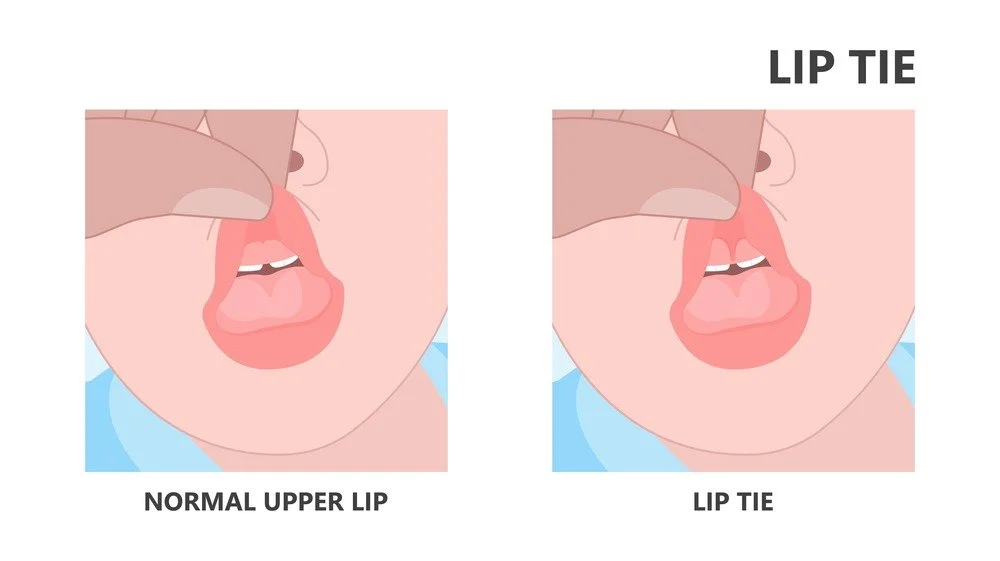
A "lip tie" usually refers to a prominent or restrictive maxillary labial frenulum, the small fold of tissue that connects the inside of the upper lip to the gum.
This tissue is a normal part of infant anatomy. In fact, the AAP notes that the maxillary labial frenulum is present in all infants.
You may notice that the frenulum looks:
Thick
Prominent
Attached relatively close to the gumline
More visible when you gently lift the upper lip
However, a visible or prominent frenulum does not automatically mean there is a lip tie that needs treatment.
This is important because some grading systems have been used to classify the appearance of an infant's upper lip frenulum, but research has found poor reliability between examiners. The AAP also notes that visual appearance alone has not been shown to reliably predict breastfeeding problems.
In other words, looking under your baby's lip and seeing a prominent frenulum does not give you the whole picture.
The better question is:
How is your baby actually feeding?
Lip Tie Baby Signs: What Parents May Notice During Feeding
When parents search for lip tie baby signs, they are usually looking for clues that their baby's upper lip may be affecting feeding.
Some feeding behaviors are commonly attributed to lip tie, but it is important to understand that these signs are not specific to a lip tie. They can happen for many different reasons.
Possible feeding concerns include:
1. Difficulty maintaining a latch
Your baby may repeatedly lose the breast or bottle nipple, need frequent repositioning, or have difficulty maintaining a comfortable seal.
A poor latch can have many causes, including positioning, nipple flow, oral-motor coordination, tongue movement, milk supply or flow, and other feeding factors.
2. Milk leaking from the mouth
You may notice breast milk or formula leaking from the corners of your baby's mouth during feeding.
This can happen when a baby has difficulty maintaining an effective seal. However, leaking by itself does not diagnose a lip tie.
3. Clicking or smacking sounds
Some babies make clicking, smacking or other unusual sounds while breastfeeding or bottle feeding.
These sounds can sometimes indicate that a baby is losing suction or working hard to coordinate sucking, swallowing and breathing.
But again, there are many possible reasons for clicking. It should be evaluated as part of the bigger feeding picture rather than used as proof of a lip tie.
4. Long or inefficient feeds
If your baby consistently takes a very long time to finish a feed, falls asleep before finishing, or seems to work extremely hard to get milk, it is worth looking at the feeding mechanics.
An infant who is spending a lot of energy feeding may need support with positioning, oral-motor skills, milk flow, coordination or another underlying issue.
5. Frequent breaks during feeding
Some babies repeatedly pull away, reposition their mouth or seem frustrated during feeds.
This can be related to flow rate, fatigue, swallowing coordination, reflux-like symptoms, sensory factors, or oral-motor difficulties. A feeding assessment can help determine what is actually happening.
6. Difficulty with bottle feeding
The same concerns can show up during bottle feeding.
A baby may have trouble creating a seal around the nipple, leak milk, click while sucking, fatigue quickly, or struggle to coordinate sucking, swallowing and breathing.
The nipple shape and flow rate can also play a major role, so it is important not to assume that a frenulum is responsible.
Lip Tie Symptoms in Infants: Is It Really a Lip Tie?
This is where things get complicated.
Many lists online describe things such as reflux, gas, fussiness, poor sleep, sucking blisters, or poor weight gain as lip tie symptoms in infants.
These symptoms can certainly occur in babies who are having feeding difficulties, but they are not specific enough to tell us that an upper lip frenulum is the cause.
For example, a baby who is swallowing a lot of air may become uncomfortable or fussy. But swallowing air can happen for many reasons, including an inefficient latch, bottle flow, positioning or immature feeding coordination.
Similarly, poor weight gain requires a broader medical and feeding assessment. It should never be assumed to be caused by a lip tie.
The AAP specifically notes that proposed signs such as poor lip flanging, lip dimpling, blanching of the frenulum when the lip is lifted, and reflux have not been adequately supported by peer-reviewed evidence as indicators of a problematic maxillary labial frenulum.
That is why a good evaluation looks at function first.
Lip Tie vs Tongue Tie: What's the Difference?
One of the most common questions parents have is about lip tie vs tongue tie. Although the terms sound similar, they involve different oral structures.
Lip tie
A lip tie generally refers to a concern involving the maxillary labial frenulum, which connects the inside of the upper lip to the gum.
The question is whether the tissue is actually restricting function. Current evidence does not establish that the appearance of the upper lip frenulum is a reliable indicator of breastfeeding difficulty, and routine surgical release of the maxillary frenulum is not supported by current AAP recommendations.
Tongue tie
A tongue tie, medically called ankyloglossia, involves the lingual frenulum, the tissue underneath the tongue.
A restrictive lingual frenulum can limit tongue movement. In some infants, this can contribute to breastfeeding difficulties, particularly when there is a clear functional problem that does not improve with appropriate feeding support.
The important difference is that tongue movement plays a direct role in infant feeding mechanics.
That does not mean every baby with a tongue tie needs a procedure. The AAP recommends a comprehensive feeding assessment and notes that frenotomy should be considered only when significant functional impairment is present and nonsurgical support has not resolved the problem.
Can a Baby Have Both a Lip Tie and Tongue Tie?
A baby can have a prominent upper lip frenulum and a restrictive lingual frenulum at the same time.
However, seeing both does not automatically mean that both are causing feeding problems or that both need to be released.
This is one reason a comprehensive assessment matters.
If a baby is struggling with feeding, it is easy to focus on something that can be seen inside the mouth. But feeding is a complex skill involving:
Sucking
Swallowing
Breathing
Tongue movement
Jaw movement
Lip movement
Oral coordination
Posture and positioning
Sensory regulation
Milk flow and bottle mechanics
A feeding professional can look at how all of these pieces work together.
What Should You Do If You Suspect a Lip Tie?
If you are concerned about your baby's feeding, you do not need to diagnose a lip tie yourself.
Instead, start with a comprehensive feeding evaluation.
A qualified professional may observe your baby during breastfeeding or bottle feeding and look at things such as:
How your baby latches
Whether your baby can maintain suction
Tongue movement and coordination
Lip and jaw movement
Suck-swallow-breathe coordination
Milk transfer
Feeding efficiency
Signs of fatigue
Bottle nipple and flow
Positioning
Your baby's overall feeding experience
Depending on what is found, you may be referred to or collaborate with your pediatrician, lactation professional, pediatric dentist, ENT or other appropriate provider.
This team approach is important because feeding problems can have many causes. The AAP recommends coordinated care when infants have breastfeeding difficulties, rather than assuming that a frenulum is the cause.
Does a Baby With a Lip Tie Need a Frenectomy?
This is one of the biggest questions parents have.
The short answer is: a prominent upper lip frenulum does not automatically mean your baby needs a procedure.
Current AAP guidance states that labial frenula are normal structures and that there is not evidence supporting surgical intervention on the maxillary labial frenulum to improve breastfeeding.
The AAPD similarly emphasizes that more research is needed to understand the relationship between upper lip restriction and breastfeeding and supports a team-based approach when evaluating feeding concerns.
That does not mean parents should ignore feeding difficulties.
It means the focus should be on understanding why your baby is struggling to feed before jumping to a procedure.
When Should You Get Help With Infant Feeding?
Consider having your baby's feeding evaluated if you notice persistent concerns such as:
Painful breastfeeding
Difficulty maintaining a latch
Frequent milk leaking
Clicking or smacking during feeds
Very long or tiring feeds
Frequent coughing, choking or sputtering
Difficulty coordinating sucking, swallowing and breathing
Difficulty transitioning between breast and bottle
Poor feeding efficiency
Concerns about weight gain
Significant frustration during feeds
These signs do not necessarily mean your baby has a tongue tie or lip tie.
They are simply reasons to take a closer look.
And if your baby is having trouble breathing, repeatedly choking, becoming unusually sleepy during feeds, showing signs of dehydration, or having concerns with weight gain, contact your pediatrician promptly.
What I Look At as a Feeding Therapist
As a feeding therapist, I do not want to look at a baby's mouth and immediately label what I see.
I want to see how the baby uses their mouth during feeding.
A baby's feeding skills are developing quickly during the first months of life. Sometimes the issue is the latch. Sometimes it is coordination. Sometimes the bottle nipple or flow is not a good match. Sometimes there are oral-motor or sensory factors involved.
And sometimes a frenulum may be part of the picture.
The goal is to understand what is actually happening during the feed so you can make informed decisions about what your baby needs.
That may mean feeding therapy, lactation support, changes to positioning or bottle mechanics, collaboration with another provider, or simply reassurance that your baby's anatomy is normal and does not require intervention.
The Bottom Line on Lip Tie in Babies
If you are searching for lip tie baby signs or lip tie symptoms in infants, remember this:
The way a baby's upper lip frenulum looks is not enough to tell you whether there is a feeding problem.
A prominent upper lip frenulum is common in babies, and current evidence does not support using its appearance alone to diagnose a problematic lip tie or determine that a release is necessary.
Instead, look at the whole feeding picture.
If your baby is struggling with breastfeeding or bottle feeding, a feeding evaluation can help identify what is actually getting in the way and what support may help.
Wondering if your baby's feeding challenges need a closer look?
At Myo Speech Solutions, we take a whole-picture approach to infant feeding and oral-motor development. If you have questions about your baby's latch, bottle feeding, oral-motor skills or feeding patterns, book a free discovery call to talk through your concerns and learn how we may be able to help.
Medical Disclaimer: This article is for educational purposes only and does not replace individualized medical advice. If you have concerns about your baby's feeding, latch, weight gain, breathing, or swallowing, consult a qualified healthcare professional.