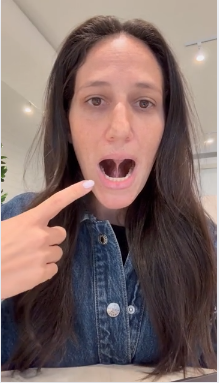
When you are not talking, eating, or swallowing, your whole tongue should rest gently against the roof of your mouth, with the tip on the small ridge just behind your upper front teeth. Your lips should be closed without strain, your teeth slightly apart, and you should be breathing quietly through your nose. This is called proper tongue posture, or healthy tongue resting position.
Most people have never checked. If your tongue sits low in your mouth, presses against your teeth, or feels tiring to hold up, it is useful information, and it is worth understanding why.
What Is Proper Tongue Posture?
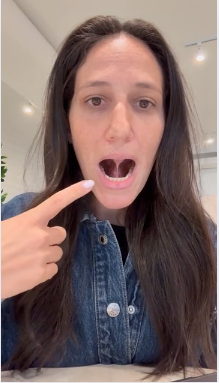
Proper tongue posture is the position your tongue takes at rest. Healthy resting posture looks like this:
The tip of the tongue rests on the ridge just behind the upper front teeth.
The whole tongue rests lightly against the roof of the mouth (the palate), not just the tip.
The lips are closed without straining.
The teeth are slightly apart.
You are breathing through your nose, quietly.
I call the roof of the mouth the tongue's home base.
Why Does Tongue Resting Position Matter?
Your tongue spends far more of the day resting than moving, so where it rests matters. Resting posture is connected to:
Jaw and palate growth in children. A tongue that rests up helps support the development of the palate and jaw. I like to say the tongue acts as a natural palate expander.
Nose breathing. Tongue posture and nasal breathing go hand in hand.
Swallowing. Resting position is the starting point for how we swallow.
Speech. It influences how some sounds are produced.
Orthodontic results. It plays a role in whether teeth stay put after braces.
This is why a speech-language pathologist who looks at tongue posture is often looking at the foundation underneath speech, feeding, sleep, and breathing.
What Causes Low Tongue Posture?
When the tongue rests low in the mouth, there is usually a reason. Common causes include:
Tongue tie (restricted tongue movement)
Enlarged tonsils or adenoids
Allergies and nasal congestion
Long-term thumb sucking or pacifier use
A habit pattern that has simply been there for years
Sorting out which cause is driving the pattern is the real work. Sometimes that means bringing in an ENT, dentist, or orthodontist so the whole picture is covered, not just one piece.
How to Check Your Own Tongue Posture (One-Minute Test)
Stop and notice where your tongue is right now. Do not move it.
Ask: Is it pressed up against the roof of my mouth? Lying low on the floor of my mouth? Pushing against the back of my teeth?
Check your lips. Are they closed without effort?
Check your breathing. Is it quiet and through your nose?
Check in three times today: in the car, at your desk, and while scrolling your phone at night. If keeping your tongue up feels hard or tiring, that is not a failure. That is information.
For parents: Watch your child during a show or while they play. Do not correct them. Just notice whether their lips are together and whether they are breathing through their nose.
When Should You See a Specialist?
A one-time check is a good starting point, but consider an evaluation with a speech-language pathologist or orofacial myofunctional therapist if you notice:
A child who breathes through the mouth during the day or while watching a show
Ongoing feeding difficulty, picky eating, or bottle refusal in a baby
Speech sounds that are not coming in clearly
Snoring, restless sleep, or nighttime mouth breathing
Jaw tension or tightness
Teeth shifting after braces
These signs do not automatically mean something is wrong, but they are worth a closer look, especially if you have already seen other providers and still feel stuck.
Frequently Asked Questions
Where should your tongue rest in your mouth?
Your whole tongue should rest lightly against the roof of your mouth, with the tip behind your upper front teeth, lips closed, and teeth slightly apart.
Is it bad if my tongue rests on the bottom of my mouth?
A low resting tongue is common, and it is not a moral failing. It can be connected to tongue tie, enlarged tonsils or adenoids, allergies, or long-standing habits. An evaluation can help determine whether it is worth addressing.
How does tongue posture affect children?
In kids, a tongue that rests up supports the growth of the palate and jaw, and goes along with nose breathing. It also relates to swallowing, certain speech sounds, and how teeth sit after orthodontic treatment.
What is orofacial myofunctional therapy?
Orofacial myofunctional therapy is therapy that targets the muscles and habits of the tongue, lips, jaw, and face, including resting posture, breathing, and swallowing. It is the layer underneath speech and feeding, and it is often overlooked.
Can a speech-language pathologist help with tongue posture?
Yes. A speech-language pathologist with myofunctional training looks at tongue resting posture, breathing, swallowing, speech, and feeding together, and can coordinate with an ENT, dentist, or orthodontist when needed.
What are signs of poor tongue posture?
Common clues include lips that do not stay closed at rest, mouth breathing, a tongue that sits low or pushes against the teeth, and a tongue that tires when you try to hold it up.
Why I Do This Work
When I was in 7th grade, I volunteered with Friendship Circle and was paired with a little boy named Shai. He was born healthy, then had a stroke at 18 months old and lost almost everything he had learned. I was in the room when he said his first word after the stroke: "ball." That was the moment I knew I wanted to become a speech-language pathologist and feeding specialist.
I also saw how Shai's parents bounced from provider to provider, piecing answers together. Everyone was treating a piece of Shai. His parents were the only ones holding the whole picture.
Later, working with my own families, I kept meeting kids who were stuck. Before a child can talk clearly or eat comfortably, the foundation has to work: how the tongue rests, how they breathe, how they swallow. That is what led me to orofacial myofunctional therapy, and it is why I look at the whole picture.
Work With a Myofunctional Therapist in Manhattan, New Jersey, or Virtually
At Myo Speech Solutions, I work with babies, kids, teens, and adults on myofunctional therapy, pediatric feeding, speech and language, and TMJ concerns. I see clients in Manhattan and New Jersey, and virtually in New York, New Jersey, and Florida.
If you have tried the specialists, the bottles, the therapies, and the waiting, and you are still stuck, let's step back and look at the whole picture together.
Book a free call with Myo Speech Solutions today.
Jessica Hutter is a speech-language pathologist and certified myofunctional therapist and the founder of Myo Speech Solutions. This article is for general education and is not a substitute for an individual evaluation or medical advice.