Why My Baby Chokes on the Bottle But Not the Breast
You're holding your baby close, bottle in hand, ready for what should be a peaceful feed and then it happens. The sputtering, the coughing, that wide-eyed panic that sends your heart straight into your throat. You pull the bottle away, rub their back, and wait for them to settle. And the whole time, one thought is running through your head: why does this keep happening?
Because here's the thing: at the breast, your baby is perfectly fine. Slow, steady swallows, a contented rhythm, a drowsy milk-drunk baby at the end. But the moment a bottle enters the picture, everything falls apart. It doesn't make sense, and it's scary, and you just want it to stop.
If your baby chokes on the bottle but not the breast, you're not doing anything wrong. This is genuinely one of the most common concerns parents raise in those early weeks and months, especially when switching between breast and bottle. The good news is that there's a clear reason it happens, and once you understand it, fixing it becomes a lot more manageable.

Why Does My Baby Choke on the Bottle?
The short answer is that the bottle delivers milk faster than your baby can handle it. At the breast, your baby is the one in charge. They squeeze, latch, and pace the flow themselves, with natural pauses built right into the process. With a bottle, milk flows freely from the moment the nipple enters their mouth, driven by gravity and pressure rather than by your baby's own effort.
When that flow comes faster than your baby can coordinate swallowing and breathing, their airway reflex kicks in. The result is coughing, sputtering, or pulling off the bottle in distress. That mismatch between flow speed and your baby's ability to keep up is the root cause of almost every bottle-choking episode.
The Real Difference Between Breast and Bottle Feeding
It helps to understand just how different these two feeding experiences are because they're not interchangeable, even though both deliver milk to your baby.
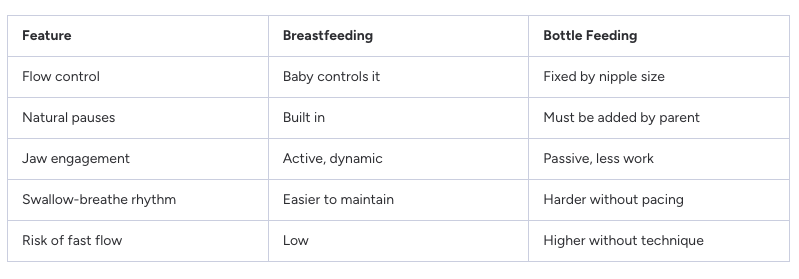
When your baby nurses, they're actively working for every drop. They control the latch, which affects how much milk flows. They control the pace, pausing and re-latching as needed. Milk doesn't release unless they actively suck, and even then, it arrives in waves rather than a constant stream. The breast itself changes shape in their mouth, allowing their jaw and tongue to regulate the flow naturally. All of this gives your baby built-in brakes, a rhythm they set themselves.
A bottle works on an entirely different system. Once the nipple is in your baby's mouth, milk flows — regardless of whether your baby is ready for it. The nipple doesn't compress or respond the way breast tissue does, the flow rate is fixed by the nipple size rather than your baby's effort, and there are no natural pauses unless a caregiver deliberately creates them. The result is that your baby may be receiving milk faster than they can comfortably swallow it, with little room left to breathe between gulps.
The Three Reasons This Happens
The Nipple Flow Is Too Fast
This is the most common culprit, and it's easy to overlook. Fast flow nipple choking happens when the nipple delivers milk faster than your baby's swallowing ability can keep up with. Many parents assume they should size up the nipple flow as their baby grows, but for breastfed babies especially, that's often the wrong move. A breastfed baby is used to working for their milk. Switching to a faster nipple can feel overwhelming like going from a slow drip to a stream they can't control.
The signs are usually pretty clear: milk dripping from the corners of their mouth, gulping and gasping during feeds, repeatedly coming off the bottle, a baby who seems stressed or frantic during what should be a calm moment. If any of that sounds familiar, going back to a slow-flow or Stage 1 nipple is almost always the right first step, regardless of your baby's age.
Their Swallow-Breathe Coordination Is Still Developing
Newborns and young infants are still building the neurological skill of coordinating swallowing and breathing at the same time. At the breast, natural pacing gives them the micro-pauses they need to manage this. At the bottle, without those pauses, they can get overwhelmed quickly. Their airway reflex steps in — coughing, sputtering, pulling off because that's the body doing exactly what it's supposed to do. It's protective, even if it's distressing to watch. As babies grow, usually around four to six months, this coordination improves considerably and bottle feeds typically become much smoother.
Their Jaw Isn't Working the Same Way
At the breast, your baby takes in a wide, deep latch, and their jaw moves dynamically — compressing and releasing in a way that naturally regulates flow. With a standard bottle nipple, especially a narrow or rounded one, your baby doesn't need to work nearly as hard. That reduced jaw engagement means less natural control over how quickly milk enters their mouth, which can make choking more likely. Choosing a wide-based, breast-shaped nipple can encourage a similar latch and jaw position to nursing, giving your baby a bit more say in the process.
Paced Bottle Feeding: The Technique That Changes Everything
Paced bottle feeding is the single most effective tool for babies who choke or cough during bottle feeds, and once you try it, you'll wonder why no one mentioned it sooner. The goal is to recreate the natural rhythm of breastfeeding, giving your baby control, building in pauses, and slowing the whole thing down to a pace they can manage.
Here's how it works. Start by holding your baby in a semi-upright position, around a 45-degree angle rather than lying flat. Hold the bottle almost horizontally, nearly parallel to the floor, so gravity is working with you instead of against you. Let your baby latch onto the nipple tip first, then tip the bottle up just enough to fill the nipple. After every three to five sucks, tip the bottle back down slightly to pause the flow and give your baby a moment to breathe and regroup. If they push the nipple out or turn their head away, that's their version of "I need a second", don't rush to put it back in. The whole feed should take roughly 15 to 20 minutes, which is similar to a nursing session and gives your baby the time they need to swallow comfortably, recognize fullness, and stay calm throughout.
What to Do When Choking Happens Mid-Feed
Even with the best technique, choking can still catch you off guard. The most important thing in that moment is to stay calm, because your baby takes cues from you. Remove the bottle immediately and sit your baby upright or lean them slightly forward. Let them cough — coughing is the airway doing exactly what it's designed to do, and interrupting it isn't helpful. A gentle pat on the back is fine, but mostly your job is to wait and let them recover fully before offering the bottle again.
What you want to avoid is tipping your baby back while they're coughing, continuing the feed before they've settled, or rushing. Give them as much time as they need.
If you notice that choking happens at every single feed despite adjusting your technique, if your baby turns blue or loses consciousness (in which case call emergency services immediately), or if you're seeing consistent gagging during breastfeeding as well, those are signs to bring in your pediatrician. The same goes if your baby is losing weight or starting to refuse feeds because they've come to associate the bottle with distress.
Quick-Reference: Breast vs. Bottle Flow Comparison
Choosing the Right Bottle and Nipple
Not all bottles are created equal. For breastfed babies prone to choking, look for:
Slow-flow or newborn nipples — Stage 1 is almost always right for breastfed babies
Wide-based nipple shape — mimics the breast latch and encourages jaw engagement
Anti-colic or vented bottles — reduce air swallowing, which can contribute to discomfort and fussiness
Consistent nipple brand — don't mix and match nipple flows mid-feed
Popular options that many breastfeeding families find helpful include wide-neck, breast-shaped nipple designs but the technique matters more than the brand.
When Will It Get Better?
The reassuring truth: most babies grow out of bottle-choking episodes as their swallow-breathe coordination matures, usually between 3 and 6 months.
In the meantime:
Stick with slow-flow nipples
Use paced bottle feeding consistently
Feed in an upright position
Give your baby plenty of breaks
If you're just returning to work or introducing a bottle for the first time, give yourself (and your baby) a two-week grace period to adjust. It takes practice for both of you.
When to See a Specialist
If paced feeding and slow-flow nipples don't help after a few weeks of consistent use, it may be worth a conversation with:
Your pediatrician — to rule out reflux, tongue tie, or other anatomical factors
A certified lactation consultant (IBCLC) — they support bottle feeding too, not just breastfeeding
A pediatric speech-language pathologist — if there are signs of a deeper swallowing difficulty (called dysphagia)
Trust your instincts. You know your baby best.
The Bottom Line
When your baby chokes on the bottle but not the breast, it almost always comes down to flow control. The breast is a responsive, baby-led system. The bottle is not, at least not by default.
But with the right nipple flow, a semi-upright position, and a paced feeding approach, you can recreate much of that natural rhythm. Most babies adapt beautifully with a little patience and a slower flow.
You're paying attention. You're problem-solving. That's good parenting, and your baby is lucky to have you.
Still not sure what's going on, or tried a few things and it's not clicking? That's exactly what a discovery call is for. Book one here, and we'll figure out the right feeding plan for your baby together.
This article is for informational purposes only and does not constitute medical advice. Always consult your pediatrician or a qualified healthcare provider with questions specific to your child.